


Goldpine
Onetahua's Living Barrier
Farewell Spit, Golden Bay
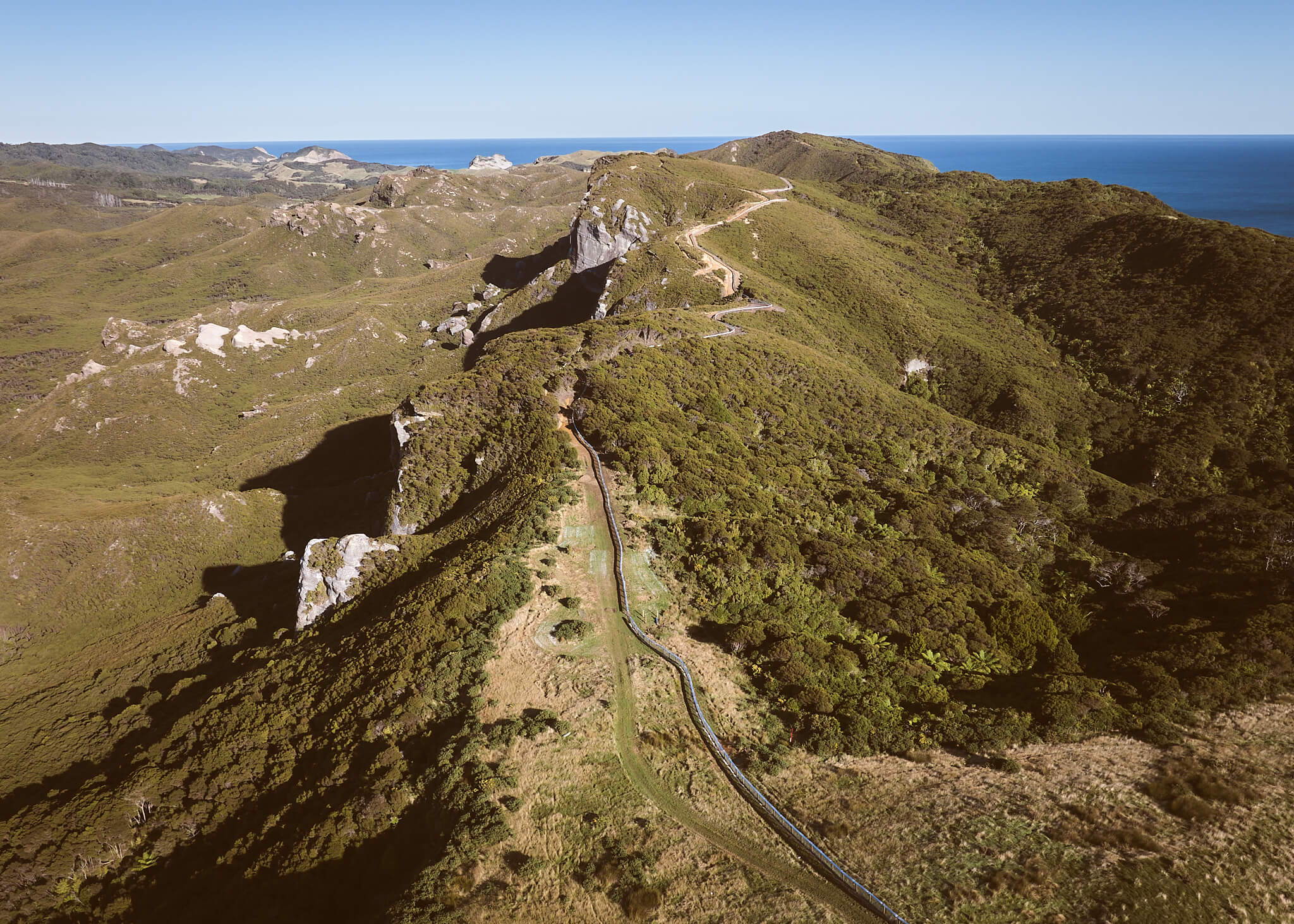
At the far northern edge of the South Island, where winds sweep in from the Tasman Sea and the sand curves outward into the long arc of Farewell Spit, a quiet but ambitious conservation project is taking shape. Between steep hill country and broad tidal flats, a predator-proof fence using Goldpine timber is being constructed across the Onetahua Farewell Spit area, with the goal of protecting one of Aotearoa’s most significant ecological landscapes.
The work is part of a wider regeneration eff ort led by the HealthPost Nature Trust, a community-driven initiative founded in 2017 by Golden Bay business HealthPost. For trustee Lucy Butler, the motivation behind the trust was both local and deeply personal.
“The HealthPost Nature Trust was founded in 2017,” Lucy explained. “We’re the largest employer in this part of Mohua, so we really wanted to look at what we could do to take the lead in regenerating this incredible and iconic part of Aotearoa.”
Golden Bay’s landscapes are among the most distinctive in the country. The region sits between two national parks - Kahurangi and Abel Tasman - and contains ecosystems found nowhere else in New Zealand. Yet despite its ecological importance, many areas have historically lacked the resources for large-scale conservation.
“It’s an incredible environment,” Lucy said. “It’s a unique ecology here. It’s between two national parks, and yet there were not a lot of resources going into its regeneration just because of constraints- the lay of the land, the largeness of the area.”
For Lucy and others involved in the trust, the opportunity was clear. “We could see there were a lot of opportunities environmentally, a lot of conservation wins that could happen here that weren’t,” she said. “There wasn’t the intention and resource going into it.”
From the outset, the Trust’s approach has been collaborative. Partnerships with Manawhenua ki Mohua, the Department of Conservation, Pest Free Onetahua, and local community groups have helped shape the project and identify priorities for restoration. “When we scoped out the initial partnerships with Manawhenua ki Mohua, the Department of Conservation, and Pest Free Onetahua that really underlined for us that there was a huge amount of potential here that wasn’t being realised,” Lucy said. “That’s what we’ve been working on the last few years.”
The collaboration with Pest Free Onetahua is implementing a multi-pronged pest control strategy critical to the project’s long-term success. It also builds on earlier work carried out nearby at Cape Farewell. There, the trust established the Wharariki Eco Sanctuary, a predator-free enclosure designed to test whether seabird restoration on the mainland could succeed. “We reintroduced the pakahā after establishing a predator-free enclosure and sanctuary there,” Lucy explained. “Now that was four or five years ago, and we’re starting to get a real proof of concept in terms of birds returning, breeding, and fl edging. That’s given us both the basis for the partnership relationships, and also the conservation wins to take on this bigger project here at Onetahua.”
The biodiversity of the Farewell Spit region is remarkable by any measure. The area is designated as a Ramsar wetland of international signifi cance, recognising its importance for migratory birds and fragile coastal ecosystems. “It’s protected as it’s a huge haven for seabirds and shorebirds, as well as being key for migratory species like the godwit.”
Birds are only part of the story. Rare plants, insects, and reptiles like the Nelson Green Gecko and other native species also depend on the fragile mosaic of dunes, wetlands, and coastal grasslands that make up the largest sandspit in Aotearoa. Spanning over 32km, its remote location and unique landforms create ideal nesting and feeding habitats for wildlife.
In recent years, research has begun to reveal just how much biodiversity still survives in the region - sometimes in unexpected places. “There have been some really pleasant surprises,” Lucy said.
“Based on monitoring work undertaken by Pest Free Onetahua, we discovered there are some great spotted kiwi coming through, which is a really cool opportunity to look at what we can do for that species with this current fence project.”
For many species already living on the spit, even modest reductions in predator pressure could make a critical difference. “There’s a remnant tītī, or sooty shearwater colony here and a little blue penguin colony which will receive protection from this fence, keeping stoats out.”
At the same time, the project aims to create conditions where species once lost from the mainland might eventually return. “We’re really excited to see how the pakahā develops,” Lucy said.
“We might be getting the beginnings of a colony happening here - potentially the fi rst on the mainland for 100 years or more.” Even the possibility is remarkable. “It’s still small beginnings,” she added, “but it’s pretty exciting.”
Turning that vision into reality requires practical work on a formidable scale. Grant Williams, the contractor responsible for building the fence alongside the team at Golden Bay Fencing, describes the task in straightforward terms. It is designed to protect approximately 2,000 hectares of habitat - an area large enough to support thriving wildlife populations if predators can be controlled. “The purpose is excluding predators - mainly pigs, stoats, rats, and hedgehogs - from this amazing area.”
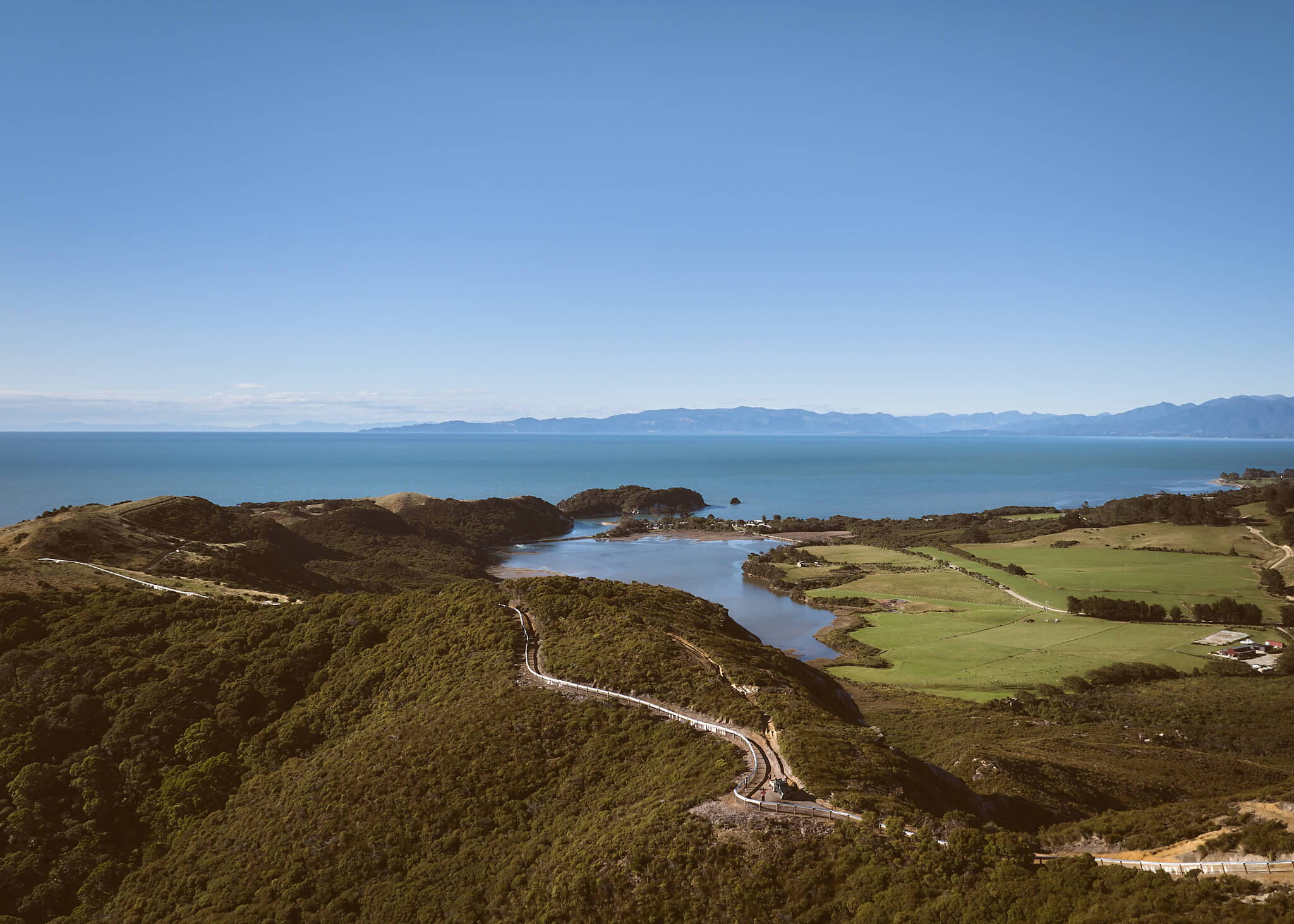
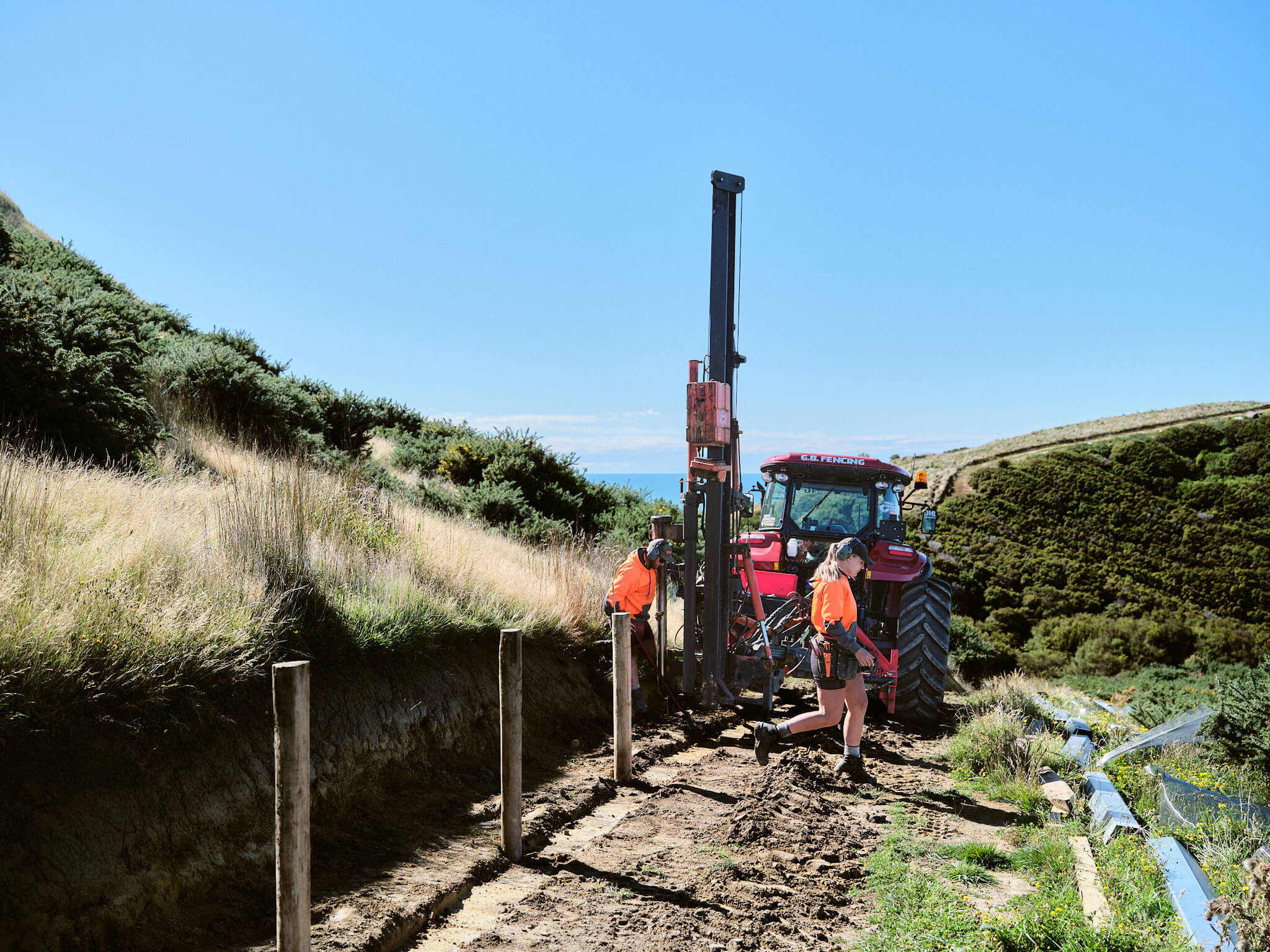
The fence stretches 3.6 kilometres across the landscape, connecting the Tasman Sea on one side to tidal flats on the other. Construction began in November 2025 on steep, remote and difficult terrain, at the mercy of weather delays. Despite these obstacles, the project is progressing steadily thanks to an experienced local team.
Unlike the tall predator fences seen in some urban sanctuaries, the Onetahua fence uses a lower-profi le design adapted to the windy coastal environment. “The fence height is 1,200 millimetres to the top of the capping,” Grant said. “It will exclude everything bar deer, goats and cats, which we can manage by other means.”
The design is based on research conducted at Lincoln University and incorporates several features intended to prevent animals from climbing, squeezing through, or digging under.
“It’s a Kiwi design,” Grant said. “We’ve used Goldpine timber railing - good old four-by-two between the posts - and then metal capping sourced from Nelson.”
Much of the fence’s effectiveness lies underground. A trench runs along the base, where netting extends outward in an L-shape before being buried beneath soil. “The purpose of that is to stop digging animals like pigs, stoats and rats.” Even so, ongoing monitoring will be essential. “We’ll need to check the fence regularly because of water erosion, trees falling and feral pigs,” he said. “It’s a big job.”
The scale of the undertaking has required substantial support from the local community. So far, volunteers have contributed more than 15,000 hours to the wider project. Local groups, conservation organisations, and iwi have all played roles in shaping the project’s direction. “Key partnerships with Manawhenua ki Mohua, the Department of Conservation and Pest Free Onetahua, who are leading pest control on the ground, as well as the fencers like Grant and Golden Bay Fencing, have been really important,” Lucy said.
The initiative has also been supported fi nancially by members of the public through a crowdfunding campaign, which raised $110,000 for the project. “We were blown away by the level of support - we are incredibly grateful for that, and hope everybody who has contributed really feels like they are a stakeholder and a part of what we are achieving.”
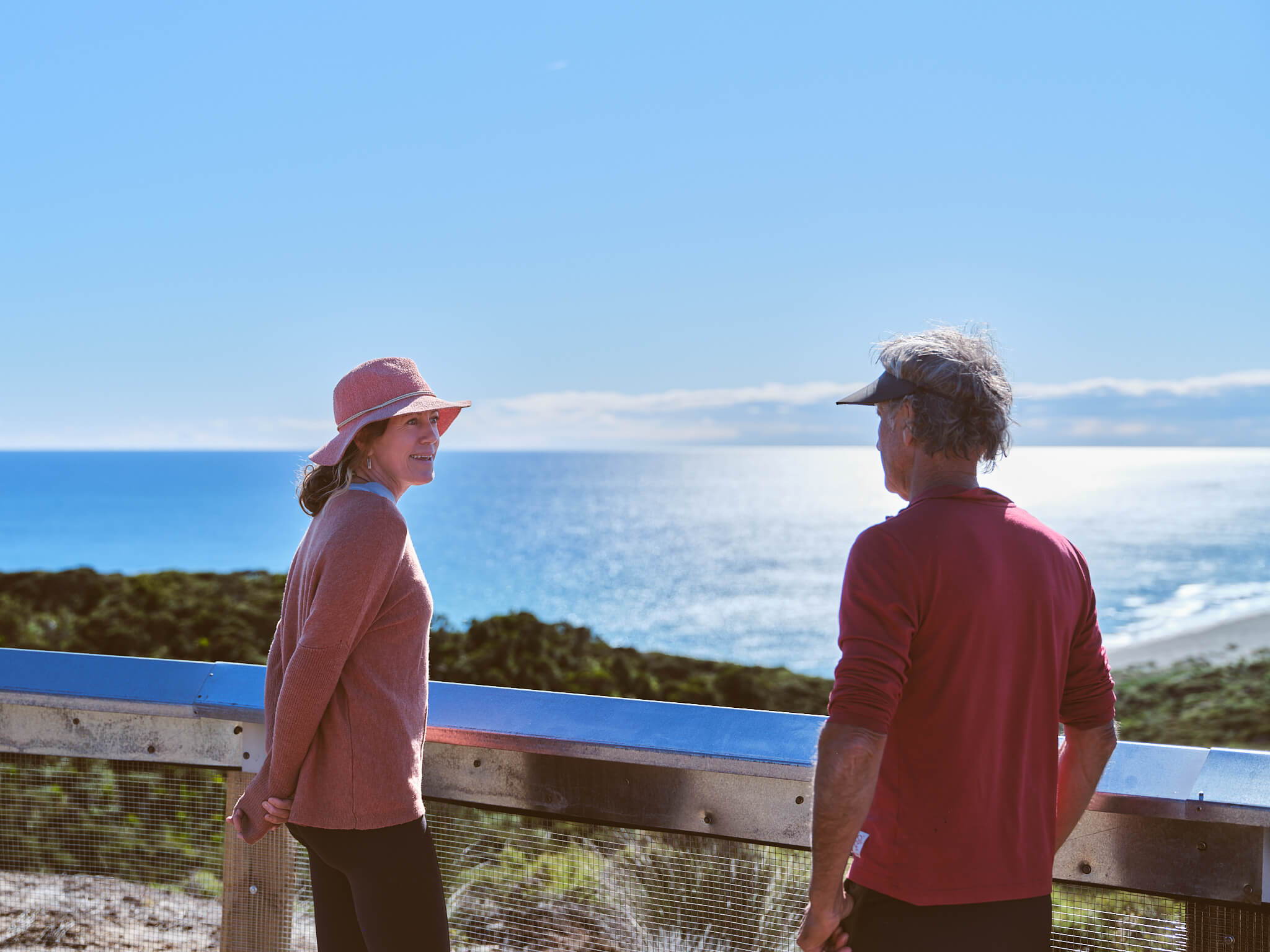
While the fence is designed to protect wildlife, the project also recognises the importance of public access. Farewell Spit and the surrounding areas attract large numbers of visitors each year, many of whom travel through Golden Bay while exploring nearby national parks. “It’s a really beloved recreational zone,” Lucy said. “It has high visitor numbers, both international and local. It’s dear to many people’s hearts, so we’re really making sure we enhance that experience rather than limit it. This fence we’re working on now will actually create a great walking track, which will be marked and accessible to the public. We’re hoping to get a lot more information out there about what is so special and unique, both culturally and ecologically, in this area. I think there’s a real opportunity there for a richer visitor experience.”
“That’s really what we’re doing it for,” Lucy continued. “The fence is exciting, but what’s really exciting is what that enables.” Among the possibilities being explored are reintroductions of kiwi and takahē - two iconic native birds that could potentially thrive in the protected landscape.
For Grant, the project represents something broader than the physical structure he has been building. “This whole thing is about connection,” he said. “It’s not about connecting the components of the fence entirely, but about connecting to the environment,” he said. “That’s good for the area, and it’s also good for people.”
When the vision behind the fence succeeds, Onetahua may once again become what it was long ago - a landscape alive with birds, thriving ecosystems, and a community committed to protecting them for generations to come